The four major customer decisions have observable later callbacks. Use a named save before each hand-in, choose the route you want, and verify it from the follow-up scene instead of one dialogue line. For a positive route: offer Hashimoto free work and ask about the Pokia, restore Yui’s Eggotchi data, help the Student, and help rather than report the former Gangster. Keep each pre-hand-in save until the later callback confirms the choice.
September 7 route answer
For a positive route: offer Hashimoto free work and ask about the Pokia, restore Yui’s Eggotchi data, help the Student, and help rather than report the former Gangster. Keep each pre-hand-in save until the later callback confirms the choice.
The four choices that change your route
These are the four customer decisions to protect if you are aiming for a positive finale. The wording can vary slightly by localization, so follow the intent and confirm the later callback rather than matching one English button word for word.
| Character | Important choice | Positive result |
|---|---|---|
| Hashimoto | Offer free work and ask about the Pokia's history | Positive landlord route |
| Hoshino Yui | Restore the Eggotchi data, not only the display | Family story route |
| Student | Help with the confession and continue listening | Positive Student route |
| Former Gangster | Help instead of reporting him | Redemption route |
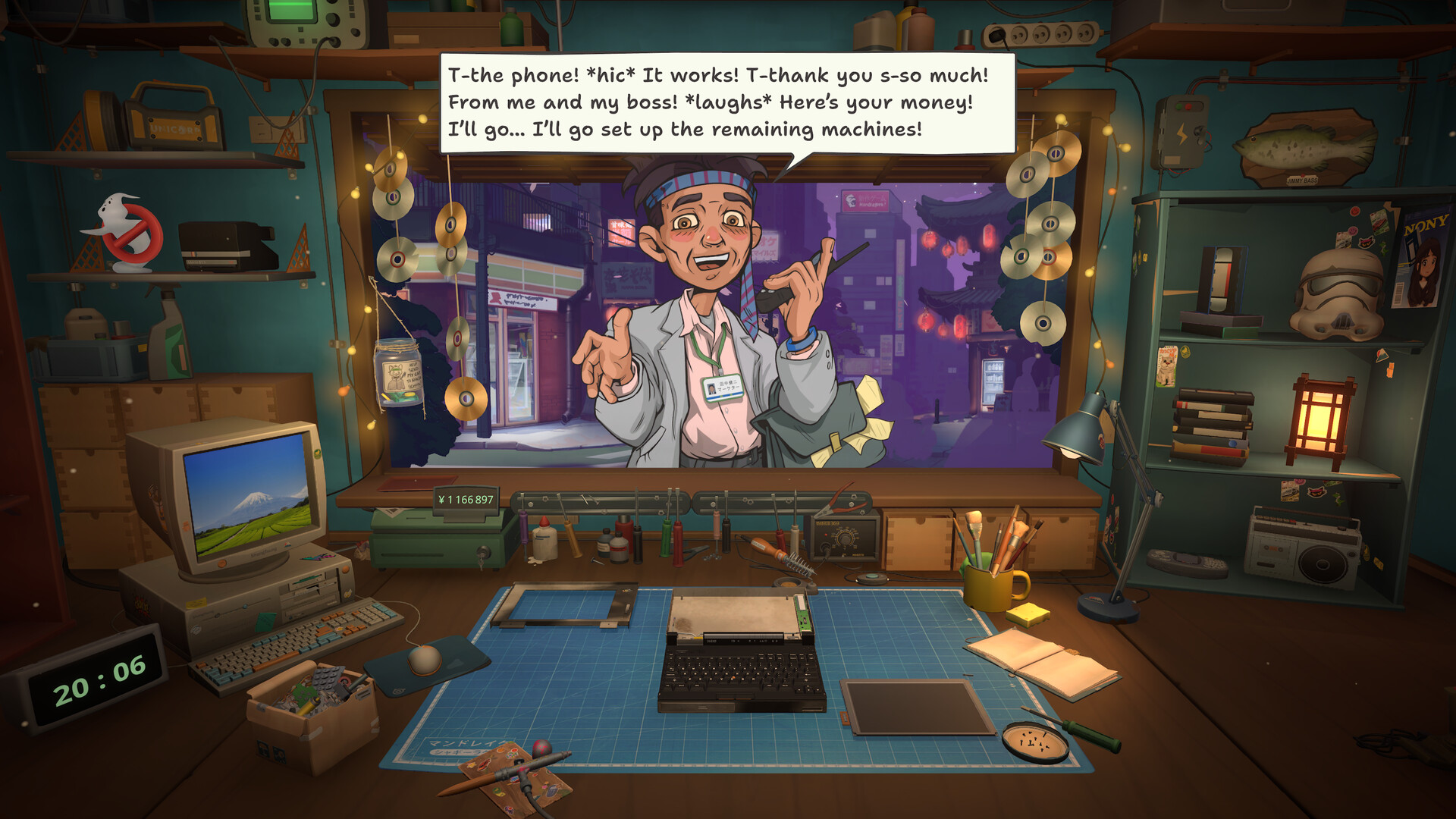
A completed repair can unlock the next dialogue, achievement, or story beat. Save before mutually exclusive choices when the route matters.
Hashimoto choice and consequence
When Hashimoto brings in the Pokia, offer to repair it without charging and ask about the device's history. Continue talking to him after the first hand-in. The extended positive route eventually leads to the special drawer and information about the shop's previous owner; that later event is the clearest confirmation that the choice registered.
Eggotchi data choice and consequence
For Hoshino Yui's Eggotchi, do not stop when the hardware works again. Complete the available data-restoration objective before returning it. Restoring the stored information opens the positive family story, while a screen-only repair does not provide the same route confirmation. Keep a checkpoint immediately before hand-in.
Student confession choice and consequence
Hear the Student out and agree to help with the confession. Continue the later questions instead of treating the first supportive line as the end of the arc. The later cross-customer connection is the observable signal needed when you are checking the extended Secret route.
Gangster report choice and consequence
Do not report the former Gangster if you want the positive route. Help him move toward legitimate work and support him again when he returns. Use a separate branch save to see the reporting outcome; do not overwrite the positive checkpoint until his callback appears.
How choices affect all four endings
Resolving all four first-stage stories positively supports the Happy Ending. Continuing their hidden callbacks supports the Secret Ending. Completing the main story without every special condition leads to the Normal Ending. Consistently taking the harmful or dismissive outcomes across these arcs leads toward the Bad Ending.
Where to save before every major choice
Create a manual save before returning each key device because the decisive dialogue often follows the technical repair. Keep one untouched blind-run archive, one positive-route save, and four named branch checkpoints: Hashimoto Pokia, Yui Eggotchi, Student confession, and Gangster phone. A named save is much easier to audit than a slot labeled only by day.
Separate mechanical success from story success
Returning a functioning device completes the repair, but the conversation around it may create a different kind of outcome. ReStory’s official description emphasizes that customer interaction can affect both individual lives and the shop. Read the request, listen to the context, and decide whether the character is asking for technical help, personal intervention, or both.
A technically perfect job is not automatic permission to use private information found on a device. When the game presents a choice about disclosure, consent, or involvement, judge it as a story decision rather than another repair objective. That distinction makes route notes much clearer.
Build a spoiler-safe choice log
Record the customer name, device, decision prompt, chosen response, immediate reaction, and any later message. Keep the wording neutral until the consequence is confirmed. For example, write “shared information” or “kept information private” rather than naming a future ending in the same line.
This format lets players check whether they have reached the same decision without exposing the result. Once a consequence is reproduced, it can be added behind a clearly labeled spoiler block. Community theories should remain marked as reports until more than one route or save confirms them.
Recognize high-impact moments
Choices deserve a manual save when the dialogue sounds final, when a customer asks you to act outside the repair itself, when private information is involved, or when a recurring character reaches a turning point. Official material uses a former gangster’s phone and a lovestruck student as examples of situations where player involvement can change a life.
Not every friendly response creates a separate ending, and not every route decision announces itself. Use rotating saves before major hand-ins and follow-up conversations. A save made after the consequence appears is useful evidence, but it may be too late to test the other branch.
Use community reports responsibly
Steam discussions, Discord conversations, video walkthroughs, and community guides can reveal where a decision appears, but they may reflect different builds or incomplete playthroughs. Compare the reported prompt with your own route and record the date. If a guide states an outcome without showing the earlier choices that led to it, treat the conclusion as provisional.
This site links to full walkthroughs for players who explicitly want them, while the written guide keeps names and outcomes separated. That gives both blind players and route planners a useful path without forcing spoilers into search snippets.
How to compare two story branches without spoiling the first run
Create a checkpoint before returning a device when the repair has revealed personal information, when a recurring customer is involved, or when dialogue suggests that your response may change more than payment. In the first branch, choose naturally and continue until the game provides a meaningful callback: a later visit, message, relationship change, story scene, achievement, or ending difference. Record the exact callback without assuming that it was caused by the most recent choice. Return to the checkpoint, change only the target response, and keep shop activity and unrelated conversations as similar as practical. Compare what changes and what remains stable. This one-variable method is slower than copying an ending video, but it separates a true branch trigger from events that merely occurred nearby. Treat privacy and consent as part of the narrative design. Repairing a device gives the player access to its contents; it does not automatically define what the character would want disclosed or acted upon. Use neutral labels such as “shared,” “withheld,” “intervened,” or “declined” in notes until a spoiler section explicitly names the result. When using community footage, confirm that the video shows the relevant earlier choice rather than only the ending. Check its upload date and language, because localization can change phrasing while preserving the underlying decision. If two reports disagree, publish the disagreement and the tested conditions instead of selecting the more dramatic claim.
- Save before the device hand-in as well as before final-sounding dialogue
- Change one meaningful response per comparison run
- Continue far enough to observe a real callback
- Separate access to private data from permission to use it
- Keep choice labels neutral outside spoiler sections
- Record localization and game build
- Use full-route footage only when it shows the earlier decision
- Call an outcome confirmed only after the branch can be isolated
A note for blind players
You do not need a perfect route to play ReStory well. The first run is valuable evidence precisely because it records what you chose without knowing the reward. Keep the natural save, write down only the prompt and your reason, and return to branch testing after the credits. If you only want help with repairs, stay on the beginner, device, and workshop pages; they are written to avoid named outcomes. If you intentionally want a route answer, compare the current build with a dated full-playthrough video and the Steam discussion that reports it. That boundary lets the same guide serve curious first-time players and completion-focused replay players without treating spoilers as ordinary navigation.
Research links
These are the primary pages used to check the facts and current release context in this guide.
Official information, observable release behavior, and community reports are deliberately separated. A community report is not presented as a universal fix until it can be reproduced or supported by current patch notes.