This walkthrough is a progression map, not a 5,000-word transcript. Follow the stage you are currently playing, then open the linked specialist guide when a repair, competition, achievement, or story choice needs detail. Read every customer ticket before touching the device, complete the tutorial interactions, and use the front-window switch when the shop asks you to open. Keep the first Pokia and Atari CX40 work in separate mental layers: identify the device, remove only visible fasteners, clean exposed targets, replace a part only when the task supports it, then rebuild in reverse.
First day: open the shop safely
Read every customer ticket before touching the device, complete the tutorial interactions, and use the front-window switch when the shop asks you to open. Keep the first Pokia and Atari CX40 work in separate mental layers: identify the device, remove only visible fasteners, clean exposed targets, replace a part only when the task supports it, then rebuild in reverse. Do not spend the starting reserve on convenience equipment before the first jobs are complete.
- Read the order and customer context
- Inspect every face before disassembly
- Group screws and parts by layer
- Check the task list before hand-in
- Create a manual save after the first clean completion
Early repairs: build one repeatable bench loop
Use the Repair Guide as the detailed manual, but keep one short loop in mind: inspect, disassemble, clean, diagnose, source, repair, reassemble, verify. A part that will not place usually signals a missing lower layer, wrong orientation, trapped cable, or overlooked fastener. Do not click every loose part at random. Record the first blocked dependency and solve that layer.
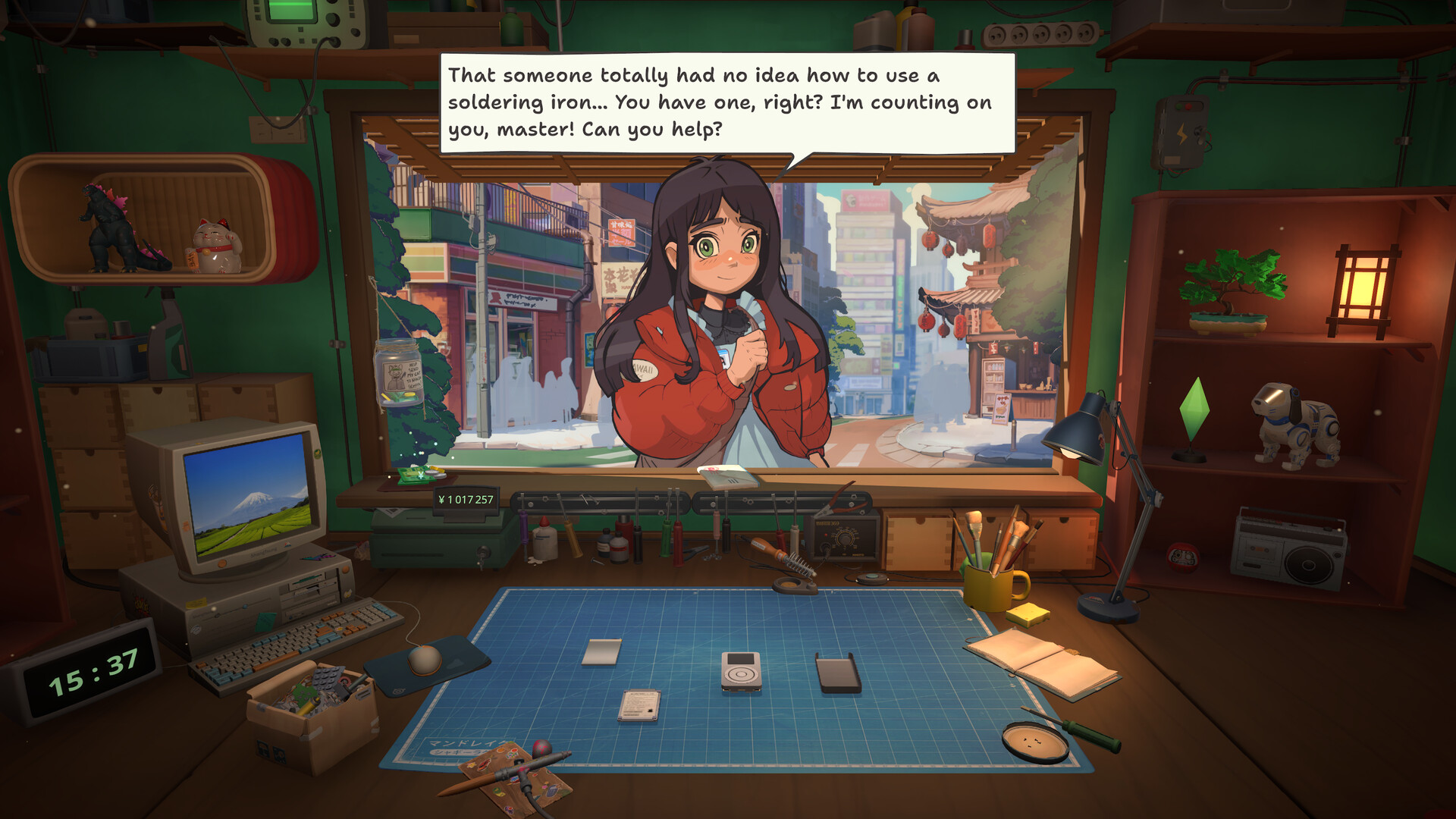
Orders begin at the counter. Read the request, then check the To-Do list before deciding that progress is blocked.
Tools, money, and the first upgrades
Protect cash for accepted work, bills, and one unexpected replacement before buying comfort upgrades. Purchase a tool when it removes a repeated bottleneck or unlocks an operation already requested by current orders. Diagnose before shopping, compare a direct part with a same-model donor, and treat parts boxes as a gamble rather than guaranteed stock. Email work and careful marketplace purchases can expand income without filling the shelves with unfinished projects.
Licenses and device progression
Buy a license because it converts observed demand into finishable work, not because it is the newest badge. Track which device families appear in customer tickets, email orders, the marketplace, or competitions; then check the tool and parts cost that follows the license. The Nony PMP preview documents a ¥40,000 license in its recorded build, but every current purchase should still be checked in game.
Assembly competitions and Aoyama Takumi
Practice the named device in ordinary work before entering a competition. Sort components, install the deepest board or mechanism, add controls and cables, close shields and shells, then return fasteners by layer. Aoyama Takumi belongs to the competition storyline, but public sources do not establish every win or score as an ending requirement. Use the Assembly Competition, Akiba Championship, and Aoyama pages together without mixing competition rewards into customer-route claims.
Character storylines and branch saves
Keep a separate checkpoint before returning a device or choosing dialogue that sounds final. For each important customer, record the device, decisive prompt, answer, immediate result, and later callback. The positive route centers on Hashimoto, Yui and the Eggotchi data, the Student, and the former Gangster. For the Baketsu, Kaito and Haruhi achievements, use separate invitation saves as a conservative plan. Some recorded routes overlap, so this is not a proven requirement for mutually exclusive playthroughs.
Mid- and late-game device work
Expand the device database by model rather than assuming similar-looking hardware shares one teardown. Atari 2600 and CX40 pages contain sourced game data; Nony PMP and Atari Lynx pages explicitly separate observed ReStory data from real-hardware references. For every new model, capture the ticket, build, visible fasteners, layer order, parts, fault, tools, and completion state. That record is more reliable than an undated screenshot.
Endings and cleanup
Decide whether to finish the first run blind before opening spoiler pages. Preserve a pre-decision save for each major customer and a late-game save before the final branch. After the ending, use the 50-achievement checklist for mechanical cleanup, then pursue Ghost in the Frame, Ronin, Melancholy, Globalization, and other story achievements with invitation choices from labeled branch saves instead of replaying the shop blindly.
Task gates: competition unlock and Tourist interval
Match the last completed hand-in and the To-Do visible in your save. A repaired item is not the same checkpoint as a collected counter item. The checks below distinguish a community route from a stalled sequence; a calendar day or third-party stage label is not a confirmed trigger. No current-build task capture is available. GamesRef supplies the stage locator, the competition guide supplies the reported installer sequence, and the Steam thread records Tourist stalls—not a universal recovery.
| Last NPC / order | Unfinished To-Do | Next trigger to check | Evidence / version | Deep guide |
|---|---|---|---|---|
| Furutsuno introduction | Soldering access or Shinji work | Finish Shinji's early repair chain | Community-documented; official trigger absent | Assembly Competition |
| Shinji repaired phone | Check whether the repaired phone is still on the counter; then distinguish missing mail, installer or app order | After collection: look for new mail → install Akiba Championship if offered → open it and check for a device order. If a step is absent, record that exact step; do not skip it or buy every licence | Community guide sequence; sender/necessary trigger and current build unverified | Assembly Competition |
| Tourist XI-Box hand-in | Record the exact To-Do after the XI-Box hand-in, including an empty list; note whether the ending/credits have appeared | Ending seen: use Post-story. Before the ending: match outstanding tasks and missing customers/mail in Story Not Progressing; no confirmed next NPC or four-win recovery | Steam thread, Aug 31 report / Sep 2 developer reply; build and recovery unverified | Story Not Progressing |
| Stage 5 cluster | Haruhi / Tourist / Sakamoto / Baketsu flags | GamesRef Stage 5 is a third-party locator, not an official chapter or a tested trigger. Match your visible To-Do; do not infer required wins from this label The game’s four story To-Dos and this website’s 29-device achievement ledger are different records. A fourth personal record can coexist with an unchecked story task. Compare the exact task, result and post-return registration before treating it as complete. Fourth story task diagnosis | GamesRef excerpt-only clue | Story Not Progressing |
Progression route at a glance
Move forward only when the current stage is stable.
| Stage | Primary goal | Open next |
|---|---|---|
| First day | Complete tutorial repairs and open the shop | Beginner Guide |
| Early shop | Build cash buffer and repeatable repair loop | Repair / Money / Tools |
| Expansion | Buy evidence-backed licenses | Licenses / Devices |
| Competition | Practice models and face Aoyama | Assembly / Akiba Championship |
| Story | Protect branch saves and callbacks | Characters / Choices |
| Finish | Choose ending, then clean up achievements | Endings / Achievements |
Fast Progress / Minimum Story Route
Community report, not a verified speedrun record: one player reported reaching all licenses around Day 16. The repeatable route principle is to prioritize required customer hand-ins, story mail, tool or license gates, and the next shop milestone; optional marketplace restoration, decoration and duplicate jobs can wait. Day 16 is a reference point, not a guaranteed minimum.
- Clear story-tagged customer hand-ins first
- Open new mail and To-Dos before taking optional work
- Buy only the tool or license blocking the next required job
- Keep bill and required-parts money in reserve
- Use a named save before championship and late-story transitions
Choosing another game after ReStory
Ready for a different workbench or a quieter story? Games like ReStory compares seven released games by repair work, customer stories, shopkeeping and cleaning, including retro cartridge restoration.