Your first hours are easier when you treat every order as three connected jobs: understand the customer, restore the device carefully, and protect the shop's cash flow. When you want a stage-by-stage route after the basics, continue with the Complete Walkthrough.
Read the request before touching the device
Start with the order details and customer conversation. ReStory is built around both the object and its owner; rushing past context can make a technically successful job feel like the wrong outcome.
Use a repeatable bench routine
A consistent process reduces missed components and wasted purchases.
- Inspect before disassembly
- Keep removed screws and parts organized
- Clean methodically rather than at random
- Replace only the component the diagnosis supports
- Reassemble and check the finished device
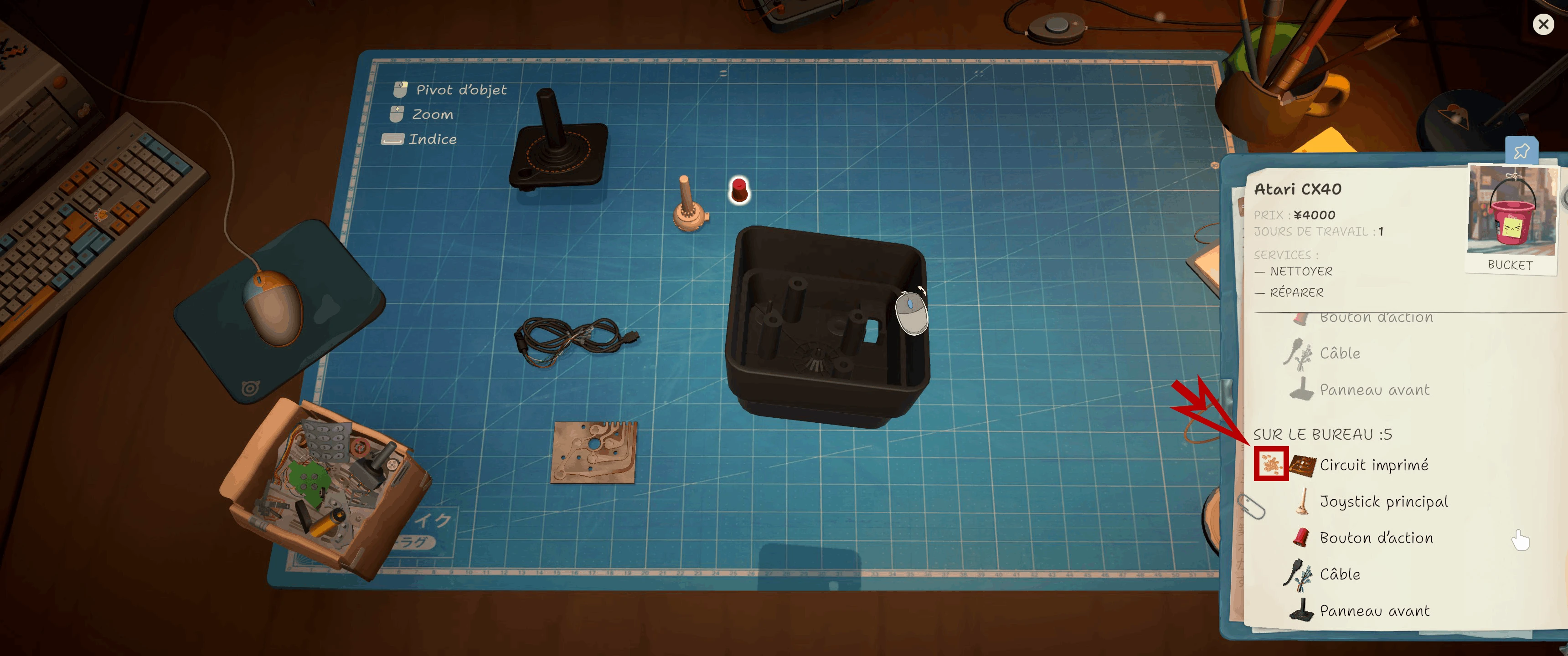
The CX40 notebook marks a dirty circuit board. Check this status before cleaning or replacing a part.
Keep a cash buffer
Parts and progression compete for the same funds. Avoid spending every coin on an upgrade just because it becomes available; keep enough liquidity to accept the next useful repair.
Pause before story choices
Dialogue is part of the progression system. If an option sounds final or invasive, decide whether you are role-playing naturally or aiming for a specific route before confirming it.
Set up a first-shift notebook
Before the first device reaches the bench, create a tiny record with five fields: customer, device, reported problem, part source, and outcome. Add a sixth field for story choices when the conversation feels important. This takes seconds and prevents the common problem of remembering a successful repair but forgetting what actually fixed it.
Do not turn the notebook into homework. Its purpose is to preserve useful facts: which browser listing supplied the part, whether a job arrived in person or by email, and which tool or license opened a blocked step. ReStory has repeatable orders alongside story jobs, so a compact log becomes more valuable as similar devices return.
Learn the interface in layers
Treat the shop as four stations. The counter gives you customers, requests, and story context. The workbench is for inspection, disassembly, cleaning, repair, and reassembly. The computer connects email work, the Y2K browser, parts, and marketplace systems. The room itself holds shelves, decoration, comfort, and long-term upgrades.
When something feels missing, ask which station owns the action. A replacement part problem usually belongs to the computer or inventory, not the device view. A dirty component belongs to the workbench. A new request may be waiting in email. This simple mental model reduces aimless clicking and makes the first hour much calmer.
Spend the first money with a reason
Cash supports parts, tools, licenses, marketplace purchases, bills, and cosmetic improvements. The safe early habit is to reserve enough for the next confirmed repair before buying convenience. A professional screwdriver or automated cleaner can be useful, but an upgrade is only efficient when it removes a bottleneck you are already meeting.
Read the requirement attached to a blocked job, compare it with the equipment you own, and buy the smallest capability that solves the problem. Licenses expand what the shop can handle, while decoration and comfort contribute to longer-term progression. Neither category is bad; timing is the difference between an investment and a distraction.
Use saves to protect curiosity
A blind first playthrough is a good way to experience the customer stories, but it does not require giving up every chance to revisit a major decision. Keep a rotating save before handing in a story-heavy device or selecting dialogue that sounds final. Use a separate slot rather than overwriting the only save from the start of the day.
For ordinary repeatable orders, saving before every screw is unnecessary. Reserve checkpoints for route decisions, expensive purchases, unfamiliar competitions, or a repair that has already shown unstable behavior. The goal is to preserve meaningful choices without turning a cozy game into constant save management.
Your first seven-job field plan
Use the first group of jobs to learn one system at a time. On job one, focus on reading the ticket and finding every outer fastener before applying force. On job two, practice a clean teardown order and notice how parts are staged on the bench. On job three, treat cleaning as a complete pass over every exposed surface rather than a race to the progress indicator. On job four, diagnose before opening the browser so the replacement purchase answers an observed fault. On job five, compare the reward with the cost of the part and begin tracking actual profit. On job six, inspect email, marketplace, license, and upgrade options without assuming every available purchase is urgent. On job seven, review the customer conversation and make a deliberate save before any response that sounds personal or final. This sequence is not a rigid walkthrough; orders can arrive differently. It is a learning framework that turns each ticket into a small lesson. If a device becomes stuck, return to the layer model: ticket, outer shell, fasteners, internal assembly, cleaning, supported replacement, reverse-order reassembly, and hand-in. If a menu seems empty, check whether the action belongs to the counter, computer, inventory, bench, or room. At the end of the shift, keep enough cash for a likely part and bill before decorating or gambling on boxes. The game is designed to be relaxed, and a short written routine protects that feeling better than frantic trial and error.
- Read the complete request before rotating the device
- Photograph or note the assembled state before the first part comes off
- Finish one physical layer before opening another
- Buy a replacement only after the symptom and exposed part support it
- Keep repair money and bill money separate from upgrade money
- Check email and marketplace between jobs, not halfway through a teardown
- Use rotating saves for story hand-ins and expensive experiments
- Leave ending and hidden-achievement guides for a later run if you want a blind story
Research links
These are the primary pages used to check the facts and current release context in this guide.
Official information, observable release behavior, and community reports are deliberately separated. A community report is not presented as a universal fix until it can be reproduced or supported by current patch notes.