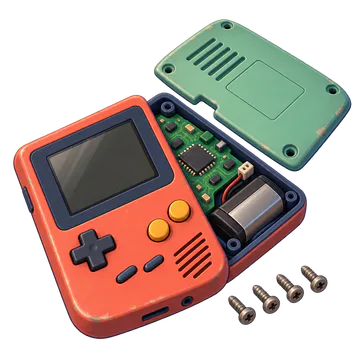
Start with the model, then use the table to see what is verified and where a dedicated repair dossier exists. Pending counts stay marked instead of being borrowed from similar hardware. The database now prioritizes complete repair records over page count. Start with Nony PlayMachine for its ten-part, twenty-screw layer map and Disc Drive cleaning reports. Nony PMP, Atari Lynx, Autorolla WT2000, and Palaloid retain their focused pages; XI-Box and Game Duck follow only after equally specific evidence is ready.
Compare recorded device data
Select up to three devices. Check each field’s evidence level before relying on it.
| Field | nony pmp | nerdio w91f |
|---|---|---|
| Parts | 13Recorded · Build not recorded | 10Recorded · Build not recorded |
| Screws | 18Recorded · Build not recorded | —Unknown · Build not recorded |
| Difficulty | —Unknown · Build not recorded | —Unknown · Build not recorded |
| Recorded sale value | ¥23,400Historical · pre-1.0.013r | —Unknown · Build not recorded |
| Common issue | Display frame can become hard to seeReported · Build not recorded | Bottom Strap attachment difficultyReported · Build not recorded |
Deep device guides before more catalog rows
The database now prioritizes complete repair records over page count. Start with Nony PlayMachine for its ten-part, twenty-screw layer map and Disc Drive cleaning reports. Nony PMP, Atari Lynx, Autorolla WT2000, and Palaloid retain their focused pages; XI-Box and Game Duck follow only after equally specific evidence is ready.
Price fields after the 1.0.013r rebalance
Marketplace purchase observations from earlier builds remain useful history, but they are not current guarantees after the official rebalance. Keep screw counts and assembly data separate from price sampling, and add a new build-stamped price only after the same model and condition have been checked.
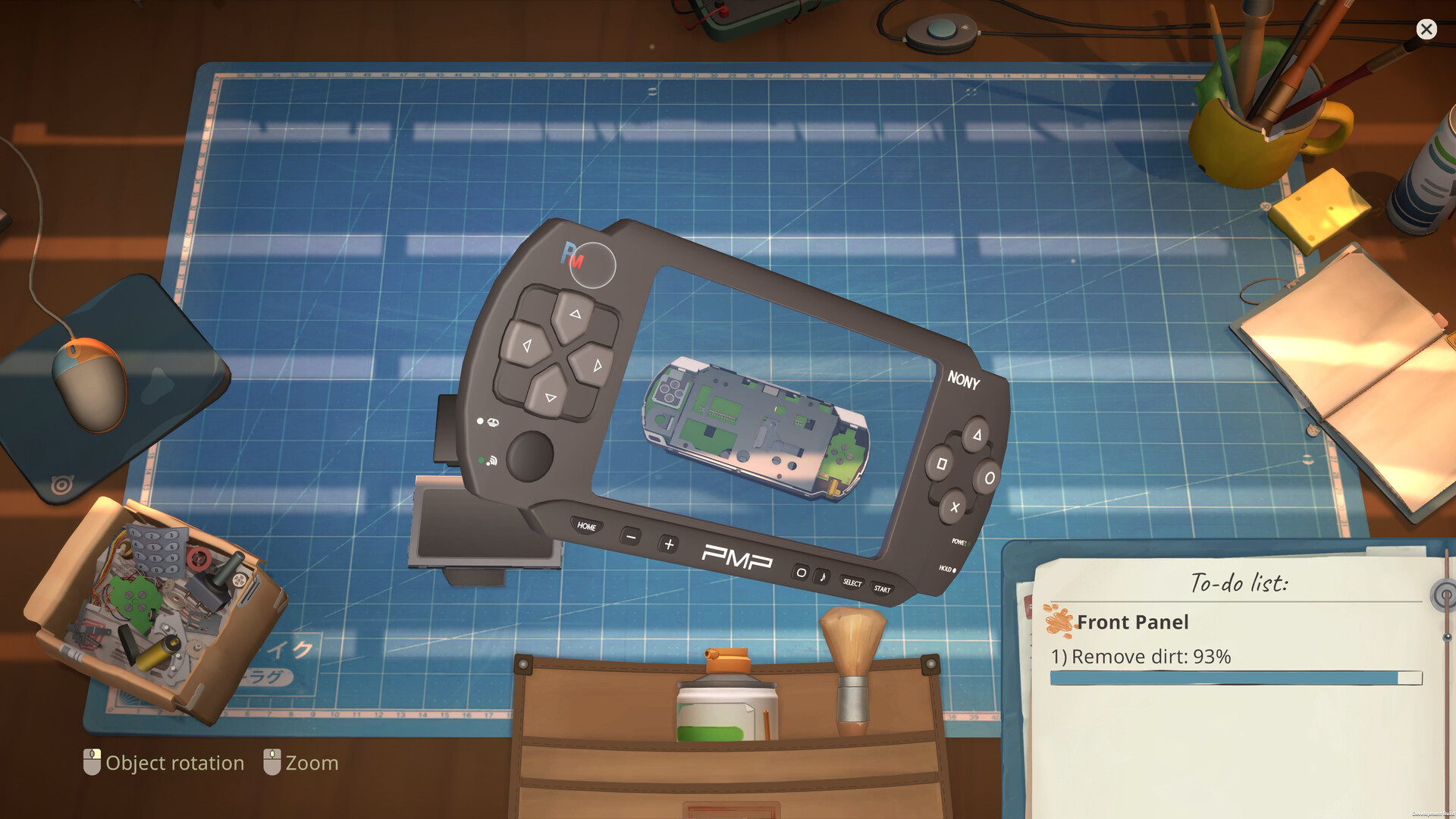
A device entry is most useful when it records the visible layer, loose parts, task state, and next operation—not just the model name.
Use the database as a repair decision layer
The database now links exact records to task-focused guides instead of creating hundreds of thin part URLs. Palaloid adds a 21-part camera record with license, price, competition, assembly, and an 86% tray-cover cleaning report. Continue using the model row to answer: what is it, what is verified, what can fail, where should parts come from, and what must be checked before closing?
Device database
Exact counts appear only when a current guide record supports them. Sale values are dated observations from build 1.0.009, not guaranteed prices. A dash means the source did not list a value; pending means the device is verified in the game but the field still needs a reproducible count.
| Device | Screws / parts | License / parts | Observed sale | Build order |
|---|---|---|---|---|
| Nony PMP | 18 / 13 | License ¥40,000 | ¥27,000 | Core → display/controls → frame → shell |
| Atari Lynx | 12 / 23 | Licensed Atari | — | Display/controls → board → rear layer → shell |
| Atari CX40 | 4 / main controls | Licensed Atari | ¥3,510 | Board/cable → controls → shell |
| Atari 2600 | Pending | Direct parts or same-model donor | ¥8,775 | Board/ports → shield/frame → shell |
| Autorolla WT2000 | Pending | Phone license · Other category | ¥18,900 | Board → display/keypad → hinge/frame → shell |
| Eggotchi | Pending | Same-model donor; story data matters | ¥4,680 | Board/display → controls → frame → shell |
| Game Duck | Pending | Per current ticket | ¥112,500 | Board/display → controls → frame → shell |
| XI-Box | Pending | Per current ticket | ¥81,000 | Board/drive → ports/controls → shield → shell |
| Palaloid | Screws pending / 21 parts | Palaloid License | ¥65,000 | Mechanism/board → controls/tray → covers → shell |
| Nony PlayMachine | Pending | Per current ticket | ¥54,000 | Board/drive → ports/controls → frame → shell |
| Nony Goman | Pending | Per current ticket | ¥36,000 | Board/drive → controls/connectors → shield → shell |
| Mapple Mypod | Pending | Firmware status varies by build | ¥31,500 | Board/display → controls → frame → shell |
| Pokia Njoy | Pending | Per current ticket | ¥25,200 | Board → display/keypad → frame → shells |
| Autorolla Razor | Pending | Phone parts | ¥23,400 | Board → display/keypad → hinge/frame → shells |
| Pokia 3310 | Pending | Per current ticket | ¥12,870 | Board → display/keypad → frame → shells |
Detailed device guides
Open the linked dossier when you need layer-by-layer context. Current detailed pages cover Eggotchi, Atari 2600, Atari CX40, Nony PMP, Atari Lynx, and Autorolla WT2000; the database expands only when model-specific evidence is available.
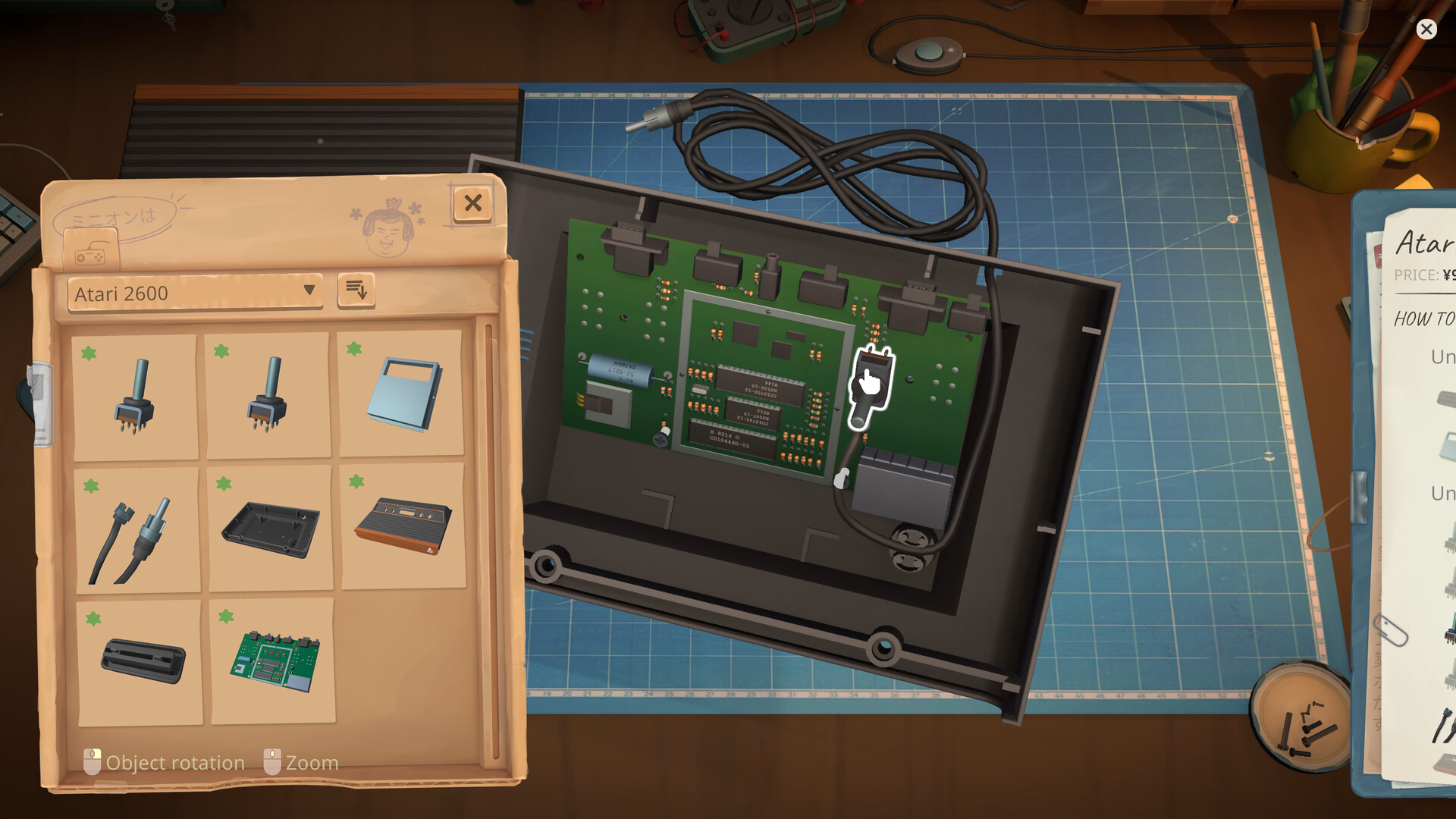
Compare the opened device with your parts list before reassembly. Keep the loose fasteners together and follow the placement prompts in your game.
Build-order rule
The short build order is a checksum, not a substitute for the placement prompts. Work from the deepest accepted part outward, keep screws with their removal layer, rotate every face before closing the shell, and reread the ticket before hand-in.
How to read the data
Exact counts appear only when a current guide record supports them. Sale values are dated observations from build 1.0.009, not guaranteed prices. A dash means the source did not list a value; pending means the device is verified in the game but the field still needs a reproducible count.
Choose the right row before opening a device
Match the manufacturer and full model name shown by the ticket, box, or marketplace listing. Autorolla WT2000 and Autorolla Razor share a brand but not a guaranteed part set; Nony PMP, Nony Goman, and Nony PlayMachine are separate device families; Atari 2600 and Atari CX40 have independent guides. Record the order source because a customer job, online order, marketplace restoration, and assembly competition can ask for different outcomes. Next copy the reported symptom, current objective, license requirement, payout, and any already-owned replacement. This five-line intake prevents the table from becoming a shopping shortcut. The sale-price column describes a completed market observation, while the license or direct-part cost determines whether the current repair can be finished profitably.
Screws and parts are completion checks
A verified screw or placeable-part count is most useful at reassembly. Separate fasteners by the layer they release, count newly reachable parts before moving deeper, and compare the final total only after every cleaning and fault objective is understood. If the table says pending, create a count from the current copy and label it with game build, order source, and device condition; do not publish that single observation as universal until a second copy reproduces it. Even a verified total does not show where every screw belongs. Use orientation notes and layer groups so twelve correct screws do not end up in the wrong Lynx supports, and so four CX40 case screws are not confused with another controller's layout.
Prices, licenses, and donor decisions
Observed sale value is not profit. Subtract the purchase price, confirmed replacement parts, any license bought specifically for the job, and the value of useful donor pieces consumed. Keep historical figures tied to build 1.0.009 until a current sale is recorded; patches or marketplace behavior may change them. A direct part is usually clearer when only one common component is needed. A same-model donor becomes more attractive when several pieces are missing or when the remaining stock can support later orders. Never buy a visually similar model merely because its real-world inspiration shares a shape. ReStory uses fictional families and simplified licensed hardware, so compatibility must be shown by the in-game listing or a reproducible placement, not assumed from appearance.
How a device graduates to a full dossier
A database row becomes a dedicated page after it has enough model-specific evidence to answer a real repair. The minimum record includes front and rear identification, verified fastener groups, placeable components, a stable teardown and rebuild sequence, supported part or donor sources, the relevant license or tool, at least one fault example, and a final completion check. Screenshots should identify orientation and the game build. Current player reports belong in a separate known-issues section so a temporary bug does not rewrite the normal assembly order. This standard explains why some high-value devices already have sale data but still show pending screw counts: a price observation proves a transaction, not a teardown.
Robby spare parts and license
Use the Robby device guide when replacement parts or Marketplace offers are missing. It separates the current third-party Robby License record from official systems and unconfirmed player reports.
Patento BS cannot be disassembled: evidence needed before a standalone guide
A discussion-list title spells the model “Pantento BS,” while this site catalog uses Patento BS. Treat spelling and symptom as a lead. Record the in-game Notebook name, order source, build, first blocked layer, visible screws or clips, and an owned close-up. Until a reproducible teardown and real step media exist, keep this index note instead of publishing a thin duplicate page.
Research links
These are the primary pages used to check the facts and current release context in this guide.
Official information, observable release behavior, and community reports are deliberately separated. A community report is not presented as a universal fix until it can be reproduced or supported by current patch notes.