The Nony PMP is a useful test of bench discipline: its current-release guide record contains 18 screws and 13 placeable parts. Treat those figures as a checksum for this in-game model, then use the job counter—not force—to find a missed layer.
Device Quick Data
- Parts
- 13
- Screws
- 18
- License
- ¥40,000
- Observed sale value
- ¥23,400
Historical
An older observation. Current values may differ.Build pre-1.0.013rPre-rebalance sale observationHistorical observation; not a current-price promise. - Competition
- —
Unknown
No reliable value is available yet.No publishable evidenceAwaiting a reproducible observation. - Difficulty
- —
Unknown
No reliable value is available yet.No publishable evidenceAwaiting a reproducible observation. - Current build
- 1.0.015
Confirmed
Supported by official information, a developer reply or first-party testing.Build 1.0.015Verified: Steam build and official announcementsSite build reference; not a test of every field. - Common issue
- Display frame can become hard to see
Reported
Player-reported behavior; results may vary by build.Build not recordedPlayer reportNot confirmed as universal.
Disassembly Layers
Layer order not yet verified; record the in-game Notebook before disassembly.
Layer-by-layer repair workflow
Checks are saved only in this browser. The full workflow stays visible.
Recorded workflow; follow the current in-game placement guide.
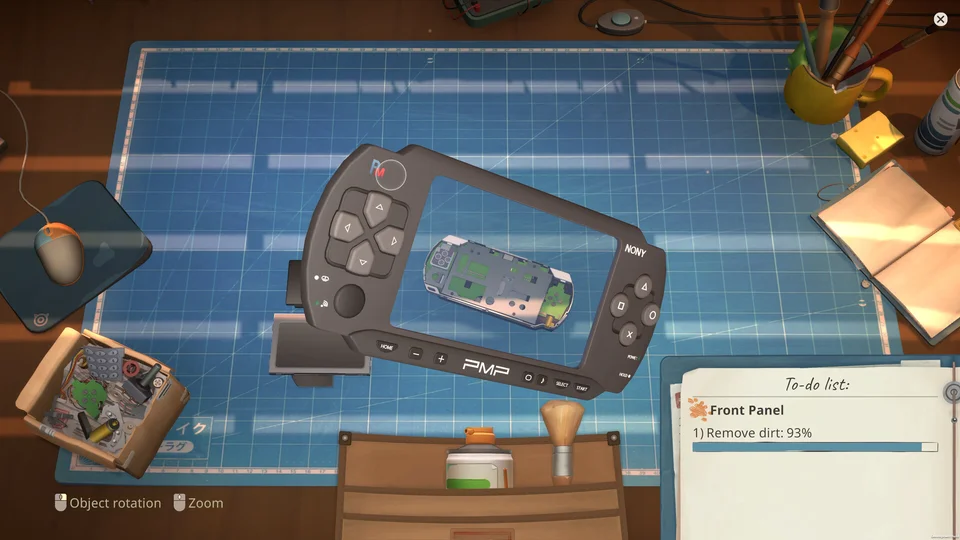
Nony PMP release-build dossier
The figures below are current-guide observations, not values published in the 1.0.010r patch notes. Patches can change an interaction, so compare the visible task counter with this record before closing the device.
| Field | Current record | How to use it |
|---|---|---|
| Screws | 18 | Count by removal layer; return each group to the same layer |
| Placeable parts | 13 | Use as a completion checksum, not a shopping list |
| License | ¥40,000 | Spread the unlock cost across multiple paid jobs |
| Observed sale value | ¥23,400 | A documented sale, not a guaranteed market price |
| Evidence status | Current third-party guide record | Recheck after a game update |
What is the Nony PMP?
The Nony PMP is ReStory’s fictional handheld game console and the exact in-game model covered by this repair guide. It is not a real Nony product or instructions for servicing comparable real-world hardware. Use the Notebook name, the on-screen layers and the recorded 13-part order when checking this job rather than borrowing a teardown from similar-looking hardware. Some third-party guides compare its shape and role with a Sony PSP; that is a guide comparison, not an official developer attribution.
Teardown: make four trays before the first click
Create groups for outer screws, shell pieces, display and controls, and the core assembly. Inspect both faces first, photograph the intact device if you keep a repair log, and remove only the fasteners exposed by the current layer. The 18-screw total is useful only when the groups remain traceable; one mixed pile makes a missing fastener harder to diagnose than the repair itself.
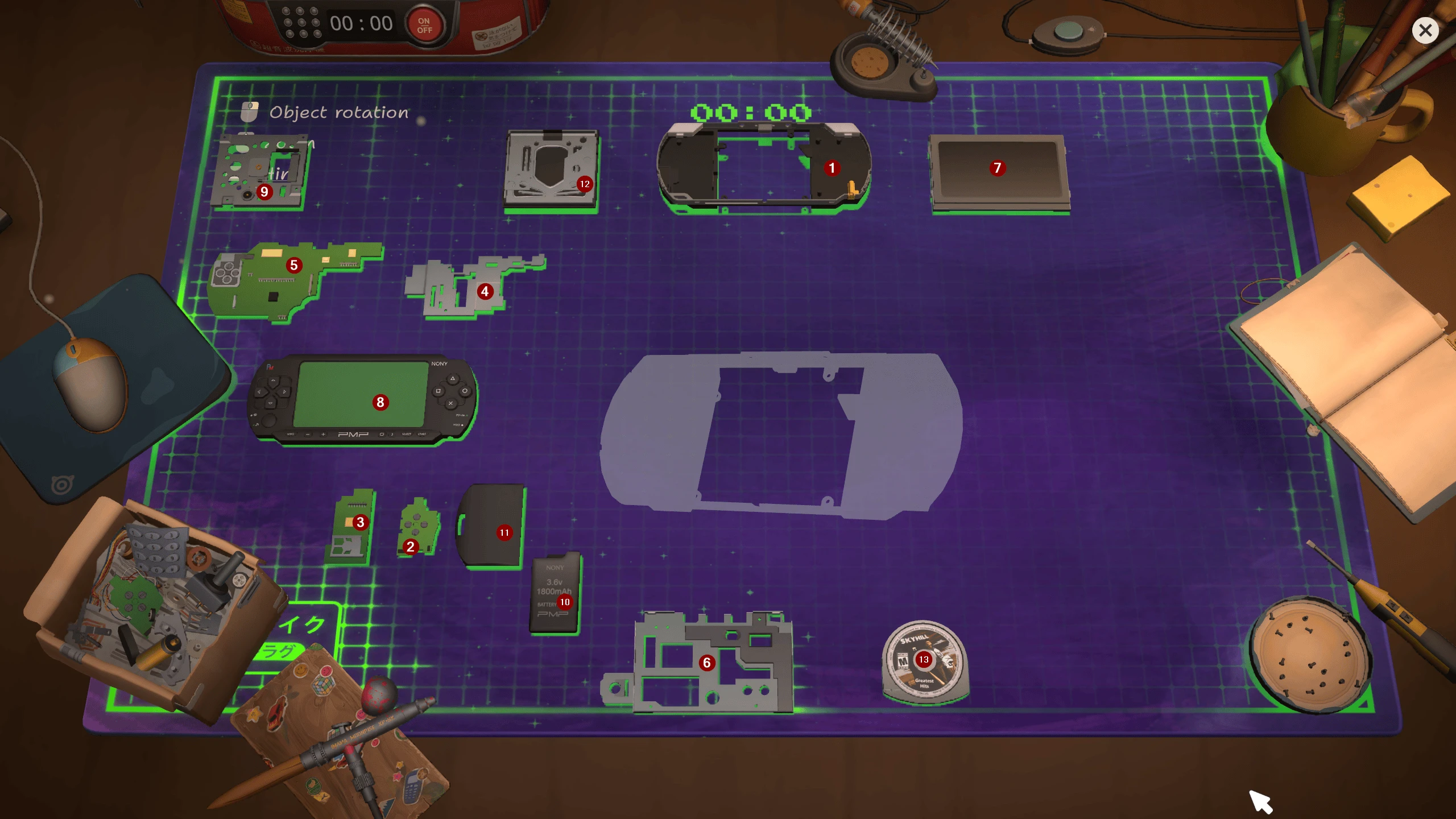
PMP parts laid out for a timed build. Compare panel and drive shapes. Competition layout; red numbers are the source author’s annotations.
Complete assembly order
Rebuild from the functional core outward. The game highlights legal placements, but this stable order prevents a shell from hiding an unfinished connection.
| Stage | Place first | Confirm before continuing |
|---|---|---|
| 1 · Core | Inner frame, main board and available internal connectors | Board lies flat; ports and cable paths align |
| 2 · Display and controls | Display assembly, buttons and side/control pieces | No cable or control is trapped under the next layer |
| 3 · Outer body | Front and rear shell pieces, trim and covers | All 13 placeable parts are accounted for |
| 4 · Fasteners | Return screws to their original layer, outside last | Counter reaches 18 and both shell halves sit flush |
| 5 · Validation | Rotate through every face and read the job objectives | No red marker, loose part or cleaning target remains |
Parts and fault decisions
The 13-part total describes assembly pieces; it does not mean every job needs thirteen replacements. Diagnose the actual red or broken component, compare a direct listing with a same-model donor, and price the repair before buying. A donor is strongest when it supplies several required pieces or leaves reusable stock. Do not replace a healthy display, control, shell, or board merely because another copy failed there.
License and resale math
The ¥40,000 license is an access cost, while the reported ¥23,400 sale is one observed outcome. Do not subtract the full license from every device. Track license cost separately, then record purchase price, replacement parts, sale or job reward, and remaining donor value. Break-even arrives across repeated work; one speculative PMP should not be expected to repay the whole unlock.
Nony PMP completion checklist
Use the in-game counters as the final authority for the copy on your bench.
- Update the game before investigating a stuck interaction
- Separate fasteners by layer and confirm 18 on the current-release model
- Account for 13 placeable parts without treating all as broken
- Build core → display and controls → shell → screws
- Inspect every face for cleaning and hidden objectives
- Record the actual payout or sale instead of assuming ¥23,400 is fixed
Nony PMP invisible frame or highlight
A current player report describes the display frame becoming almost invisible except from one angle after moving a dirty part between the mat, parts box, and dusting. Preserve the order save, return the part to the work surface, reopen the cleaning view, and capture the angle if it persists. This is a single reproducible report, not a universal Nony PMP property. Never use the accepted order's base frame as donor stock.
Exact 13-part notebook order (recorded)
This is the thirteen-entry notebook sequence documented by ReStory Help, with footage linked at 4:37:50. This is the notebook sequence; installation can differ as described below. Keep the layer summary above for orientation; use the precise item names below to check missing parts.
| Position | In-game part name | Meaning |
|---|---|---|
| 1 | Frame | Frame |
| 2 | Wi-Fi Board | Wi-Fi Board |
| 3 | Metal Frame | Metal Frame |
| 4 | Motherboard | Motherboard |
| 5 | Display Frame | Display Frame |
| 6 | Control Board | Control Board |
| 7 | Display | Display |
| 8 | Front Panel | Front Panel |
| 9 | Disc Drive | Disc Drive |
| 10 | Disc Drive Lid | Disc Drive Lid |
| 11 | Disk | Disk |
| 12 | Battery | Battery |
| 13 | Battery Lid | Battery Lid |
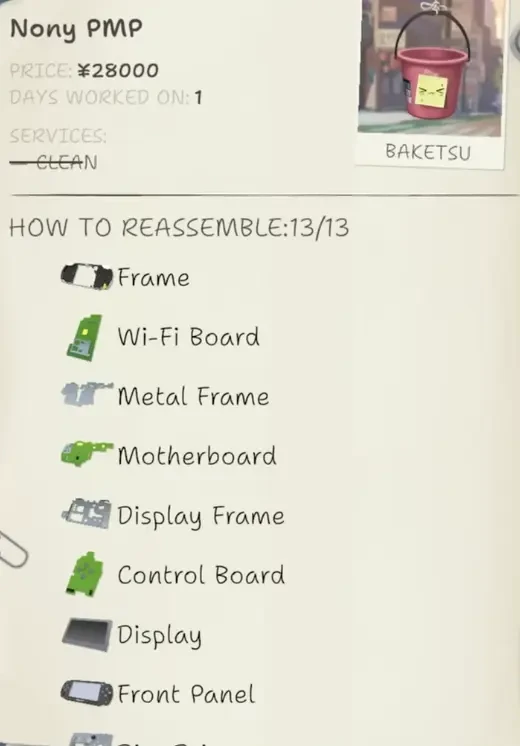
The notebook shows 13/13 and the upper entries. The lower entries are outside this crop; use the complete table beside it.
Front Panel versus Disc Drive: the reported order conflict
The notebook places Front Panel before Disc Drive. A Steam thread reports that the drive may need to go in first; replies disagree about which orders work, and later replies still describe a problem. If placement is blocked, inspect the drive mounting preview before closing the front. Do not force the notebook order, buy extra parts, or treat a reported alternative as a developer-confirmed fix. Keep a separate save and record the selected part, preview and game build.
Research links
These are the primary pages used to check the facts and current release context in this guide.
Official information, observable release behavior, and community reports are deliberately separated. A community report is not presented as a universal fix until it can be reproduced or supported by current patch notes.