The Palaloid is a 21-part camera device. Current database observations list a ¥65,000 working sale value, a ¥2,100 competition entry, and an ¥8,300 prize; use the in-game tracker as the final authority after patches. Start with the remaining objective instead of reopening every layer. These paths separate a hidden cleaning surface, incomplete assembly, locked supply access, and a competition-state problem.
Device Quick Data
- Parts
- 21
Recorded
Recorded in the linked source.Build not recordedPlayer repair records - Screws
- —
Unknown
No reliable value is available yet.No publishable evidenceAwaiting a reproducible observation. - License
- Palaloid License
Recorded
Recorded in the linked source.Build not recordedPlayer repair records - Observed sale value
- ¥65,000
Historical
An older observation. Current values may differ.Build pre-1.0.013rPre-rebalance sale observationHistorical observation; remeasure on 1.0.015. - Competition
- ¥2,100 entry · ¥8,300 prize
Historical
An older observation. Current values may differ.Build pre-1.0.013rPlayer competition recordRecheck after balance changes. - Difficulty
- Advanced
Recorded
Recorded in the linked source.Build not recordedPlayer repair records - Current build
- 1.0.015
Confirmed
Supported by official information, a developer reply or first-party testing.Build 1.0.015Verified: Steam build and official announcementsSite build reference; not a test of every field. - Common issue
- Tray cover may stop at 86% cleaning
Reported
Player-reported behavior; results may vary by build.Build not recordedPlayer reportNot confirmed as universal.
Disassembly Layers
Layer overview; follow the current in-game placement guide.
- 01
Outer shell and tray
Keep front and rear orientation - 02
Controls and flash / optical area
- 03
Internal covers and supports
- 04
Mechanism and board
⚠ The in-game placement ghost overrides this summary
Layer-by-layer repair workflow
Checks are saved only in this browser. The full workflow stays visible.
Recorded workflow; follow the current in-game placement guide.
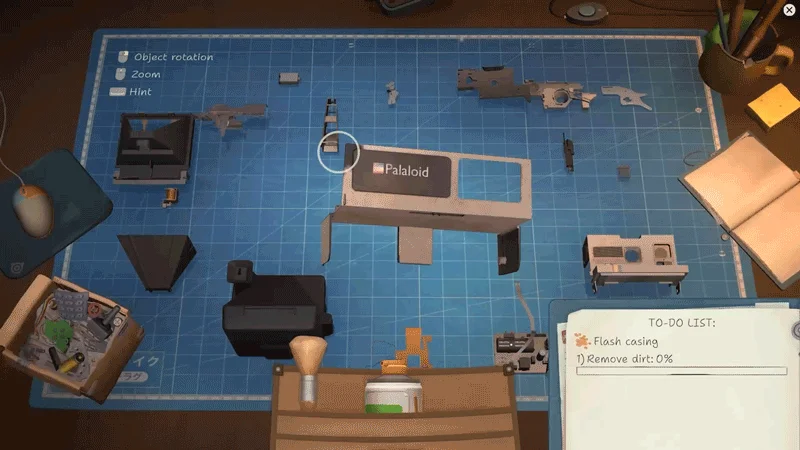
Palaloid quick diagnosis by symptom
Start with the remaining objective instead of reopening every layer. These paths separate a hidden cleaning surface, incomplete assembly, locked supply access, and a competition-state problem.
| Symptom | Check first | Next safe action |
|---|---|---|
| Tray cover stays at 86% | Both faces, rim and recessed lip | Use a smaller brush, rotate, save to another slot, then reload once |
| Device looks complete | Objective counter and 21 accepted placements | Reopen only the last incomplete layer |
| Parts do not appear | Palaloid License and supplier category | Confirm the license before buying a donor |
| Competition does not finish | Build, device, timer and result screen | Preserve the save and report reproducible evidence |
Palaloid device dossier
The device is a camera and needs the Palaloid License before its marketplace offers and supplier parts appear. The figures below are current third-party database observations, not values printed in the official patch notes.
| Field | Current record | Practical meaning |
|---|---|---|
| Distinct parts | 21 | Count every accepted placement before closure |
| Can become dirty | 20 of 21 | One unresolved cleaning target can block completion |
| Working sale value | ¥65,000 | A full fresh-parts rebuild leaves almost no margin |
| Competition | ¥2,100 entry / ¥8,300 prize | Observed net is ¥6,200 before time cost |
| License | Palaloid License | Required for marketplace offers and supplier parts |
Disassembly without inventing a screw count
No reproducible public screw census is used here. Save first, photograph the front and rear orientation, remove only highlighted fasteners, and keep each released layer together. Separate outer covers and tray pieces, control and flash-area pieces, the board or mechanism layer, and final shell hardware. Record the game build and count a part only when the game accepts it as distinct.
21-part audit and assembly order
Rebuild from the deepest accepted mechanism outward. Seat the internal mechanism and board-related pieces first; add controls, flash or optical-area pieces and tray components next; fit internal covers and supports; close the outer shell only after the tracker accounts for all 21 parts; return fasteners to their original layer; then rotate every face and reread the task. The placement ghost and objective counter override any descriptive label in this guide.
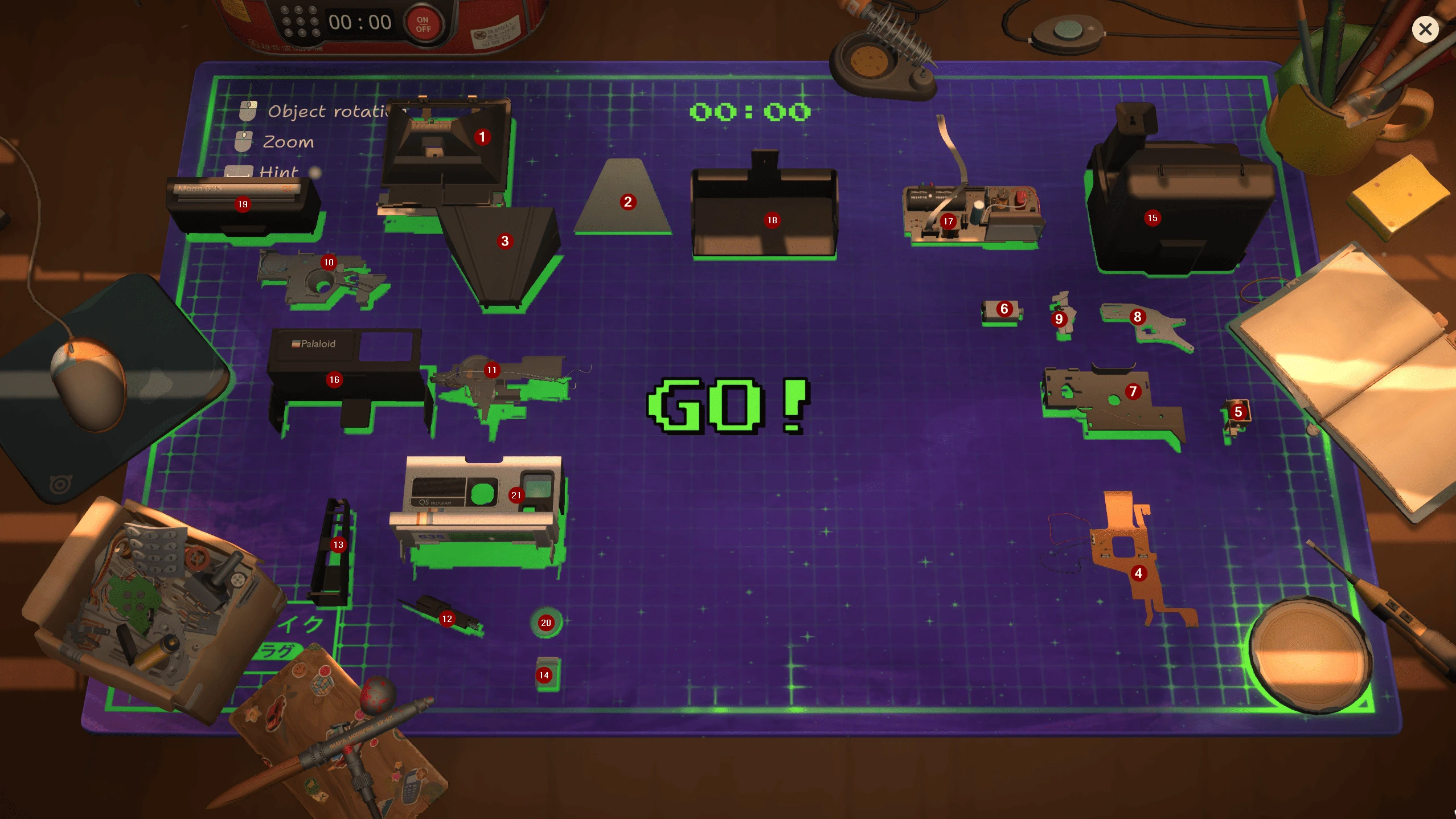
Camera shells, boards and flash parts before the timed build. Competition layout; red numbers are the source author’s annotations.
Tray cover stuck at 86% cleaning
A current Steam report describes the Palaloid tray cover remaining at 86% despite repeated brushing. Treat this as a player-reported issue, not a universal defect. Rotate the part through every accepted angle, reduce brush size for edges, inspect both faces and recessed lips, confirm the objective names the tray cover, then save in a new slot and reload once. Do not replace or shred the part merely because the cleaning percentage stalls.
Parts, donor, and profit decision
Buying all 21 replacement parts is currently recorded at roughly the complete device value, so the margin comes from parts you preserve. Diagnose the exact broken pieces before buying. Prefer direct parts when only one common component is missing; consider a same-model donor when several confirmed-good parts survive. Keep the license cost, entry fee, bill reserve, and accepted customer work outside speculative profit.
Kiyoko order and competition context
Current database records connect a Palaloid to a Kiyoko Stage 4 order and list a 4h 40m competition record. Use those values as navigation clues, not as substitutes for the current save: check the customer name, objective, reward, and event screen before committing parts. A competition copy arrives stripped, so practice the 21-part inside-out sequence during ordinary work first.
Palaloid completion checklist
Use the tracker, not the finished-looking shell.
- Confirm the Palaloid License and order source
- Save and record front/rear orientation
- Keep tray, controls, mechanism, covers, and fasteners grouped
- Audit all 21 accepted placements
- Inspect both faces of the tray cover if cleaning stalls
- Close the shell only after the objective counter is clear
- Recheck values after a patch
How many parts does the Palaloid have?
The current database record lists 21 distinct parts. Treat that as a build-dated audit figure and follow the in-game objective counter if a later patch changes the model.
Why does the tray cover stop at 86%?
The cause has not been officially confirmed. Check edges, recesses, both faces, brush size, and the named objective, then preserve the save and report the build if one controlled reload does not help.
Is the Palaloid competition profitable?
The current record lists ¥2,100 entry and ¥8,300 prize, a ¥6,200 difference before considering time and mistakes. Profit is useful only if the run does not consume customer parts or require extra replacement purchases.
Sources and evidence boundary
Device figures: https://restory.gamesref.com/devices/palaloid Current 86% report: https://steamcommunity.com/app/3812600/discussions/1/ Values and reports are dated observations; the live tracker and later official patch notes take priority.
Research links
These are the primary pages used to check the facts and current release context in this guide.
Official information, observable release behavior, and community reports are deliberately separated. A community report is not presented as a universal fix until it can be reproduced or supported by current patch notes.